
Quantum simulator shows matter popping into existence
A 13-ion machine recreates string breaking, a process linked to quark confinement.
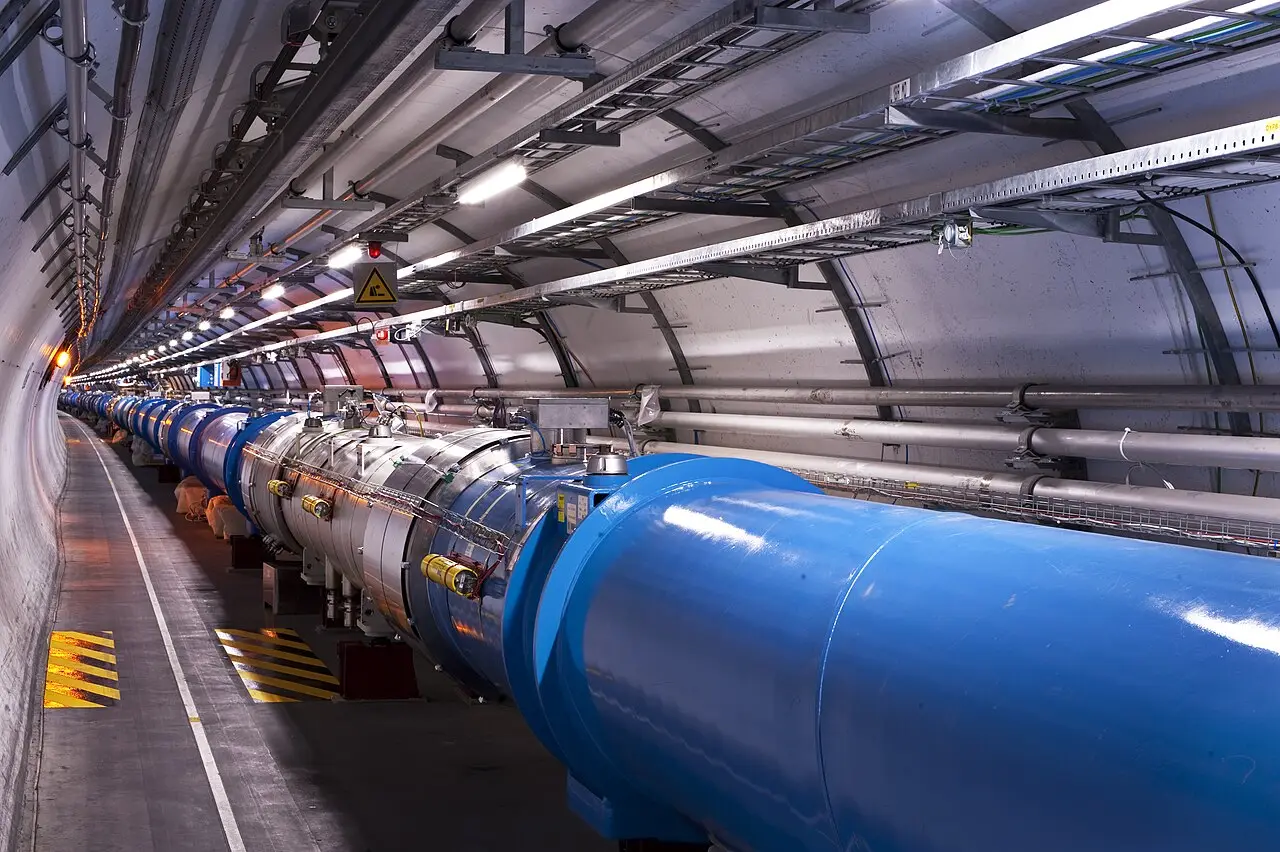
Scientists have used a small quantum computer to recreate a process in which particles appear out of energy, a phenomenon usually studied only in giant particle accelerators or through theories of the early universe.
The experiment, led from Duke University in the United States and published in the journal Nature Physics, used a quantum simulator built from 13 trapped ions to watch what physicists call string breaking.
What is string breaking?
Quarks, the building blocks of protons and neutrons, are never found on their own. If you try to pull two of them apart, the force between them behaves like a stretched string. Put enough energy into that string and, rather than freeing a quark, new particles pop into existence and the string snaps into two shorter pieces. The effect is linked to quark confinement, one of the central puzzles of particle physics.
The team built a controlled version of that behaviour in the laboratory and watched the dynamics unfold on the quantum simulator. The results were checked against modelling on conventional computers.
What the researchers said
"Quantum computer simulations provide the best platform to investigate complex questions like matter formation, short of having witnessed the Big Bang itself," said Christopher Monroe of Duke University.
Arinjoy De of QuEra Computing added: "By simulating quark confinement and string-breaking phenomena in a controlled lab environment, we're opening up new pathways."
A wider effort
The collaboration also included Zohreh Davoudi of the University of Maryland and researchers from Oxford, Caltech, Cornell and KU Leuven in Belgium. Google and QuEra Computing have independently reached similar results using different quantum hardware, which suggests the approach is robust.
The work was supported by the United States Department of Energy, the National Science Foundation and DARPA.
Why it matters
Simulating how matter forms is extremely hard for ordinary computers, because the number of possibilities grows explosively as systems get bigger. Physicists hope that quantum simulators, which follow the same quantum rules as the particles they model, will eventually tackle problems that no classical machine can, from the behaviour of matter inside neutron stars to the conditions just after the Big Bang.
More in Science
All


Latest news
Featured posts
-
Things to do
Top 10 places to visit in Birmingham
-
Food and drink
The 12 most popular food spots in Birmingham
-
Things to do
The best laser tag locations in Birmingham