
CERN begins taking apart the Large Hadron Collider for its upgrade
28 superconducting magnets are being replaced with new ones about 40 per cent stronger.
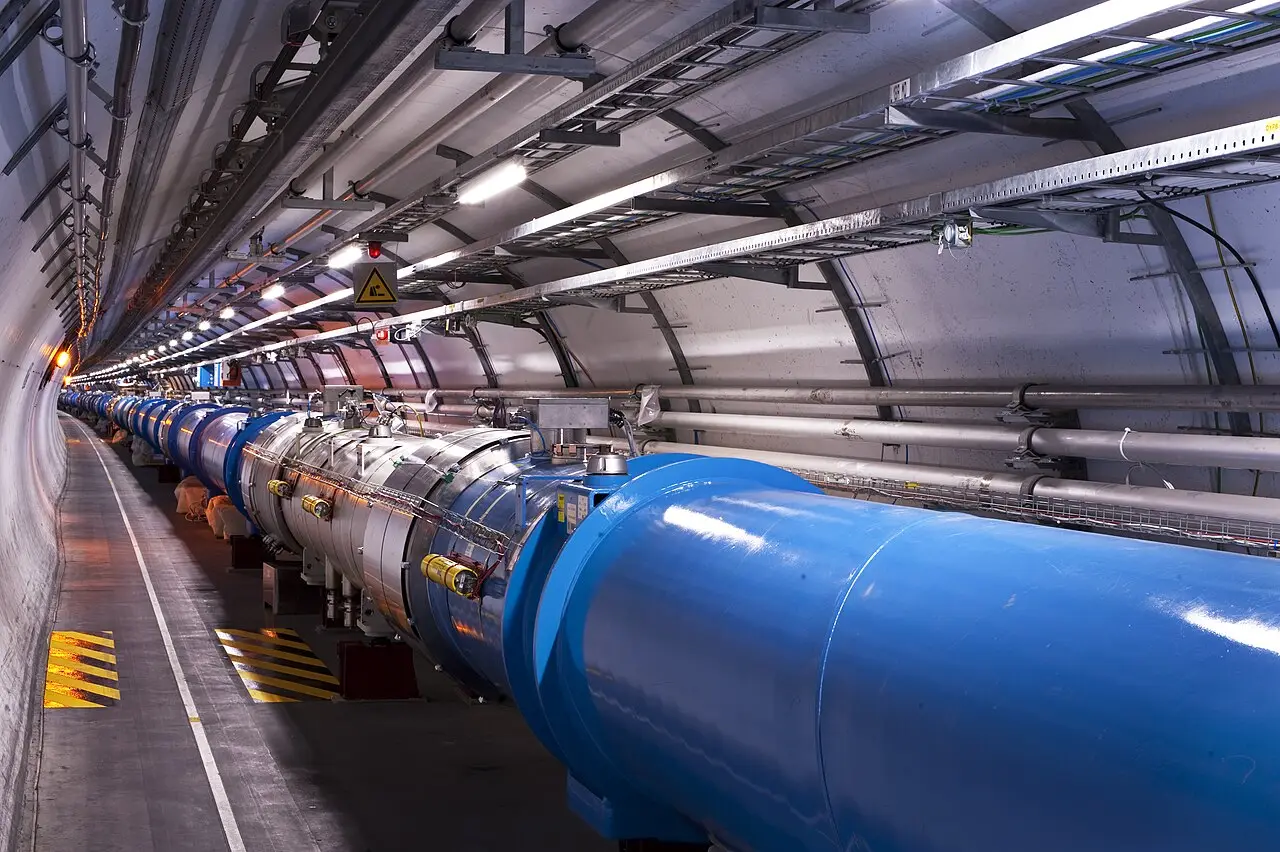
Engineers at CERN have begun dismantling parts of the Large Hadron Collider, the world's most powerful particle accelerator, as work gets under way on the biggest upgrade in its history.
The work is part of the collider's third long shutdown, known as LS3. Teams started taking sections of the machine apart on 7 September, when the first magnet interconnection was formally cut, and the laboratory near Geneva has now set out what the next few years will involve.
Stronger magnets, more collisions
The shutdown makes way for the High-Luminosity LHC, a project to increase the number of collisions the machine can produce. At its heart are new superconducting magnets that focus the particle beams more tightly just before they meet, so that far more particles collide each time the beams cross. More collisions mean more data for physicists hunting for rare processes.
In all, 28 superconducting magnets are being removed and replaced, and 16 cryostats and 28 cryo-assemblies will be installed. The new magnets reach fields of 11.3 tesla, about 40 per cent stronger than the equipment they replace, which has been in place since between 2005 and 2007. The first of the new quadrupole magnets is due to arrive in early 2029.
A new generation
Jean-Philippe Tock, who leads the LS3 coordination team, said: "The replacement of these magnets with the new HiLumi LHC inner triplets is crucial for the coming high-luminosity years."
Markus Zerlauth, the High-Luminosity LHC project leader, paid tribute to the old hardware. "After nearly twenty years of operation, they will give way to a new generation" of magnets, he said.
Why it matters
The Large Hadron Collider runs in a 27-kilometre ring beneath the border between France and Switzerland. It is best known for the discovery of the Higgs boson in 2012, which completed the Standard Model of particle physics. Physicists hope that a much larger haul of collisions will let them measure the Higgs more precisely and search for signs of physics beyond the Standard Model.
British universities, including the University of Birmingham, have long been part of the experiments at CERN, and the upgraded machine will be the focus of particle physics research for the next decade and beyond.
More in Science
All


Latest news
Featured posts
-
Things to do
Top 10 places to visit in Birmingham
-
Food and drink
The 12 most popular food spots in Birmingham
-
Things to do
The best laser tag locations in Birmingham