
Higgs boson discovery announced
Two experiments at CERN find a new particle nearly 50 years after it was predicted.
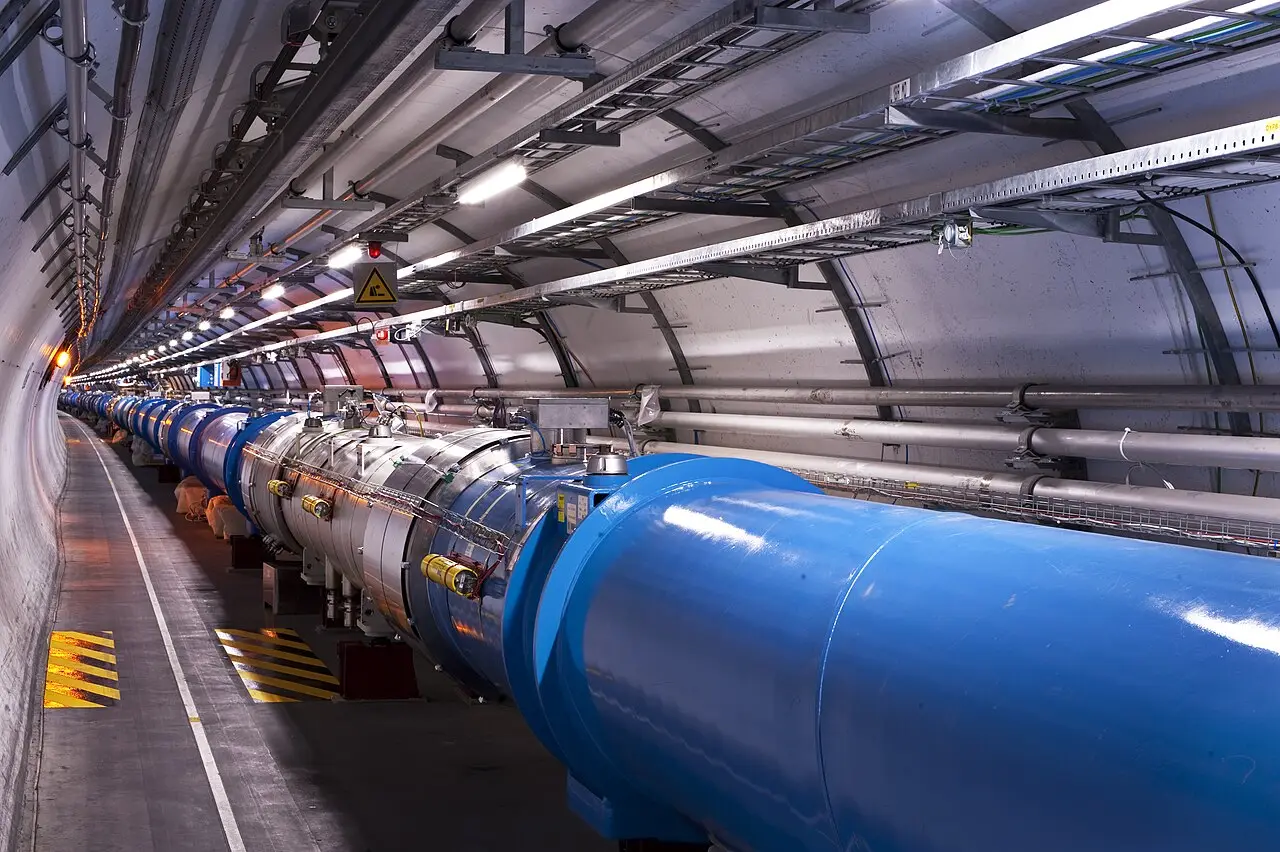
Scientists at CERN have announced the discovery of a new particle that appears to be the Higgs boson, the missing piece of the theory that describes the building blocks of the universe.
The announcement was made at a seminar in Geneva on 4 July. Peter Higgs, the Edinburgh physicist who predicted the particle nearly 50 years ago, was in the audience and wiped away a tear.
Two experiments
Two separate teams, working on the ATLAS and CMS detectors at the Large Hadron Collider, both found evidence of a new particle with a mass of around 125 gigaelectronvolts, about 130 times the mass of a proton.
Both reported results at the level of "five sigma", meaning there is less than a one in a million chance that the signal is a statistical fluke. That is the standard physicists require to claim a discovery.
The CERN director general, Rolf Heuer, said: "As a layman, I would now say, I think we have it."
What is the Higgs boson?
In 1964, Higgs and other physicists, including Francois Englert and Robert Brout in Belgium, proposed that an invisible field fills the universe, giving particles their mass as they move through it. Without it, atoms could not form, and there would be no stars, planets or life.
The Higgs boson is the particle associated with that field. Finding it confirms that the field exists.
British involvement
British scientists have played a leading role in the experiments, and universities including Birmingham, Oxford, Cambridge and Edinburgh are involved. Britain is one of the largest contributors to CERN's budget.
What next?
Scientists now need to confirm that the particle is the Higgs boson predicted by the Standard Model, or whether it is something more exotic. They will study how it decays and interacts with other particles.
Some physicists hope it will point the way to new physics, such as supersymmetry, which could help explain dark matter.
A long search
The search has taken decades and billions of pounds. The Large Hadron Collider, a 27-kilometre ring beneath the border between Switzerland and France, was built largely to find the particle.
Higgs, 83, said he never expected it to happen in his lifetime.
More in Science
All

Latest news
Featured posts
-
Things to do
Top 10 places to visit in Birmingham
-
Food and drink
The 12 most popular food spots in Birmingham
-
Things to do
The best laser tag locations in Birmingham