
Large Hadron Collider switched on
The first beam of protons travels all the way around the 27-kilometre ring.
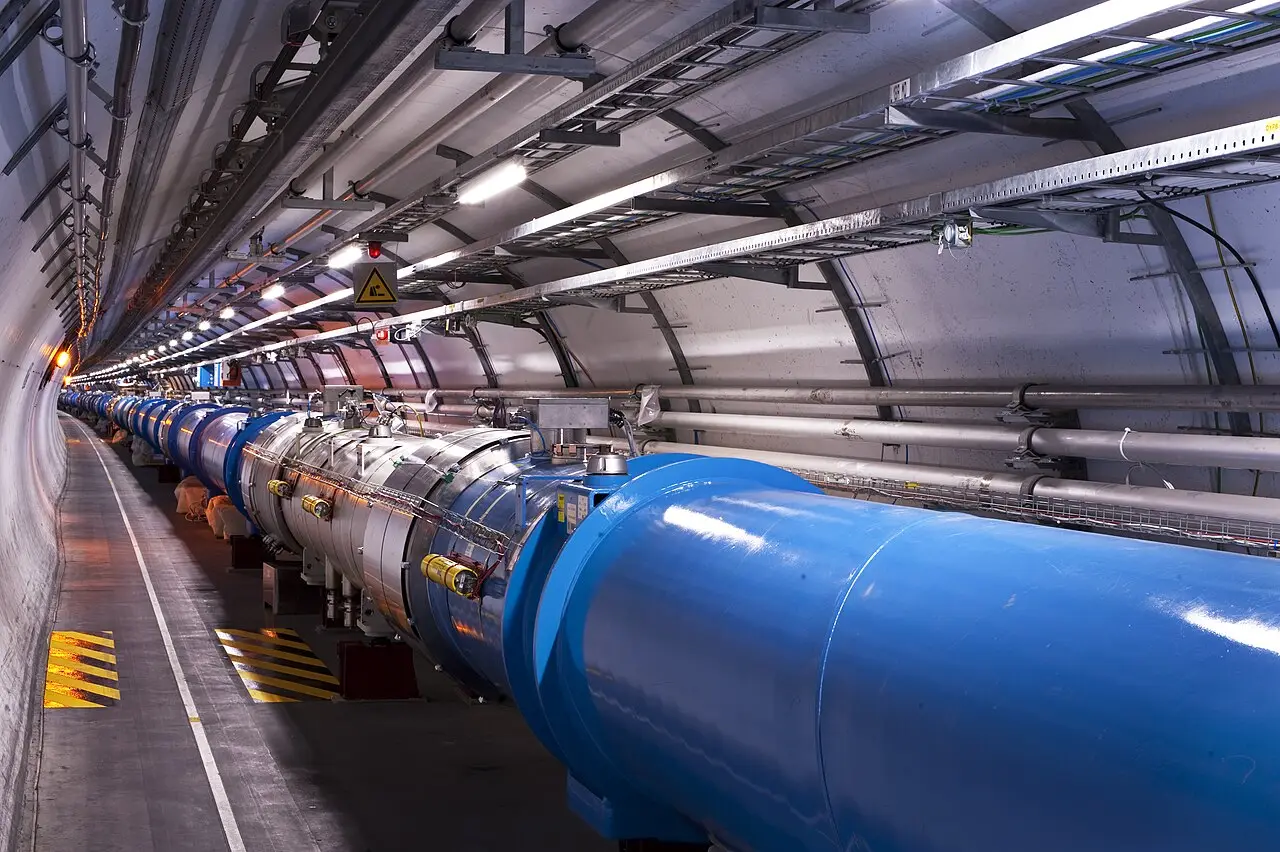
The Large Hadron Collider, the biggest and most powerful particle accelerator ever built, has been switched on near Geneva.
Scientists at CERN, the European Organization for Nuclear Research, sent the first beam of protons all the way around the machine on the morning of 10 September. The control room erupted into cheers.
The machine
The collider is a ring 27 kilometres around, buried up to 175 metres underground beneath the border between Switzerland and France. It has cost billions of pounds to build.
When it is fully working, it will smash beams of protons together at close to the speed of light, recreating the conditions that existed a fraction of a second after the Big Bang. Giant detectors will record what happens in the collisions.
The magnets that steer the beams are cooled to minus 271 degrees Celsius, colder than outer space.
Searching for the Higgs
One of the main aims of the collider is to find the Higgs boson, a particle proposed in the 1960s by the Edinburgh physicist Peter Higgs and others to explain why other particles have mass. It is the last missing piece of the Standard Model, the theory that describes the basic building blocks of matter.
Scientists also hope to find clues to the nature of dark matter, which is thought to make up most of the matter in the universe, and to learn why the universe contains more matter than antimatter.
British involvement
Britain is one of the largest contributors to CERN, and hundreds of British scientists and engineers are working on the project. Universities including Birmingham, Oxford, Cambridge and Liverpool are involved in the detectors.
Fears dismissed
The switch-on followed claims by a small number of critics that the collider could create tiny black holes that would swallow the Earth. Scientists have dismissed the fears as nonsense, pointing out that cosmic rays striking the Earth have produced far more powerful collisions for billions of years.
Next steps
The first collisions are expected in the coming weeks, once beams are circulating in both directions. It may take several years to gather enough data to find the Higgs boson, if it exists.
Physicists around the world have described the switch-on as the start of a new era in their field.
More in Science
All


Latest news
Featured posts
-
Things to do
Top 10 places to visit in Birmingham
-
Food and drink
The 12 most popular food spots in Birmingham
-
Things to do
The best laser tag locations in Birmingham