
Conservatoire becomes Royal as it moves into new Eastside home
The school, founded in 1886, has a new 500-seat concert hall and has merged with the Birmingham School of Acting.
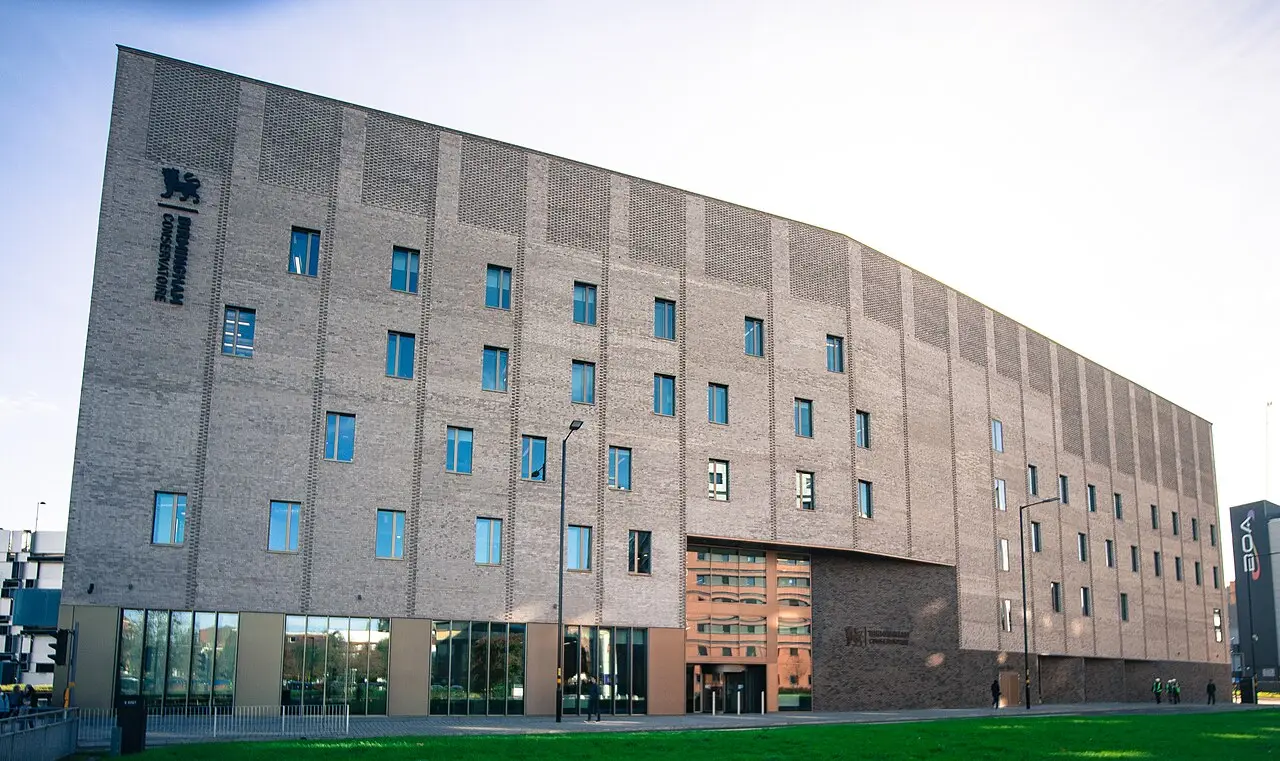
Birmingham Conservatoire has begun a new chapter with a new home and a new name. The music and drama school has moved into a purpose-built building on Jennens Road in Eastside, and has been granted royal status, becoming the Royal Birmingham Conservatoire.
The royal title was confirmed on 24 September, at the start of the first academic year in the new building.
A new building
The building, designed by Feilden Clegg Bradley Studios, has teaching and performance spaces including a 500-seat concert hall, which replaces the much-loved Adrian Boult Hall. Building work started in August 2015 and was completed in August, with Galliford Try as the main contractor on a £46 million contract.
The move was prompted by the Paradise redevelopment in the city centre. The conservatoire's former site on Paradise Circus was subject to a compulsory purchase by the city council, and in a deal agreed in December 2013 the conservatoire received £29 million in compensation, including £12.4 million of council spending. Adrian Boult Hall was demolished in June 2016.
Music and drama together
This year the conservatoire has also merged with the Birmingham School of Acting, which was founded as a drama school in 1936 and became part of the university in 2005, bringing music and drama teaching together into a single organisation.
The conservatoire is part of Birmingham City University, and is the only one of the country's nine conservatoires that is also a faculty of a university. It offers training from the Junior Conservatoire for young musicians right up to doctorate level.
A long history
The conservatoire was founded in 1886 as the Birmingham School of Music, the first music school in England outside London. It grew out of the music classes of the Birmingham and Midland Institute, which had offered music teaching since the 1850s.
Its first principal was William Stockley, whose orchestra had brought regular concerts to the town. Its second, the composer Granville Bantock, was recommended for the post by Edward Elgar. The school took the name Birmingham Conservatoire in 1989.
Students regularly perform at Symphony Hall and the Town Hall, and have played under conductors including Sir Simon Rattle and the CBSO's music director Mirga Gražinytė-Tyla.
Part of a new Eastside
The move brings the conservatoire close to the university's other city centre buildings, as Birmingham City University continues to shift its campus into Eastside. The university has invested about £220 million in campus buildings as part of that move.
The new concert hall and performance spaces are expected to become an important addition to the city's music scene, with public concerts adding to a busy cultural calendar. For a school that has trained musicians for more than 130 years, the royal title and a building designed for the purpose mark a proud moment.
More in Education
All

Latest news
Featured posts
-
Things to do
Top 10 places to visit in Birmingham
-
Food and drink
The 12 most popular food spots in Birmingham
-
Things to do
The best laser tag locations in Birmingham