
Plans for a second toll motorway to Knutsford scrapped
The M6 Expressway is dropped because of its cost and the difficulty of building it.
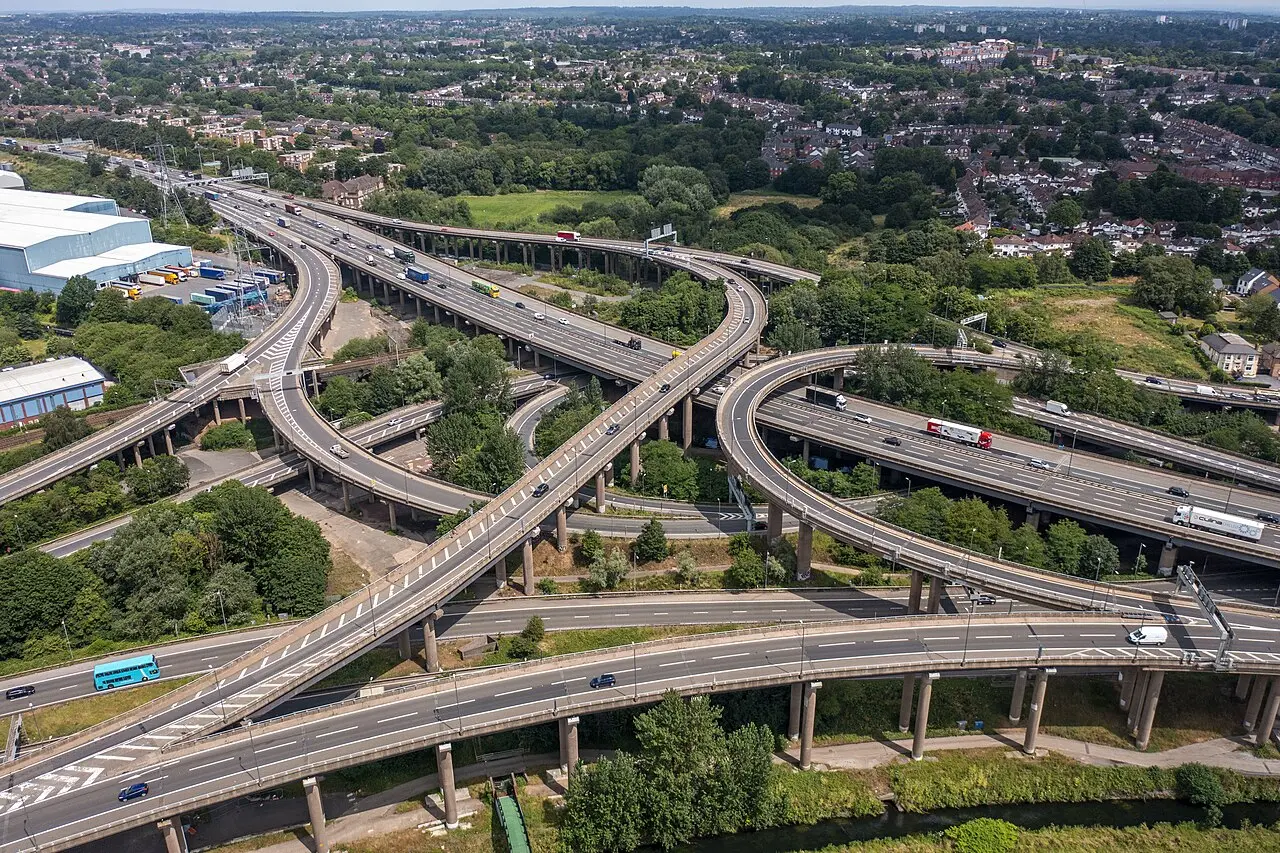
Plans for a second toll motorway running north from Birmingham to Cheshire have been abandoned by the government.
The Department for Transport announced on 20 July that the proposed M6 Expressway, which would have run alongside the existing M6 from the end of the M6 Toll to Knutsford, would not go ahead because of its high cost and the problems of building it.
What was planned
The Expressway was intended to take the strain off one of the busiest stretches of motorway in Britain. Knutsford is where much of the traffic heading for Manchester leaves the M6, and the stretch through Staffordshire and Cheshire is regularly clogged with lorries and cars.
The idea was to build a new toll road, running parallel to the M6, that drivers could choose to use instead of the free motorway. It would have extended the principle of the M6 Toll, which opened north of Birmingham in December 2003, all the way to the North West.
Critics had raised serious concerns about the scheme. It would have cut through a large area of countryside, and there were questions about whether enough drivers would be willing to pay to use it. Building a second motorway alongside the first would also have been hugely expensive, with the cost running into billions of pounds.
Lessons from the M6 Toll
The M6 Toll, built and run by the private company Midland Expressway Limited, was designed to relieve congestion on the M6 through Birmingham, one of the most notorious bottlenecks in the country. It runs for 27 miles from Coleshill to Cannock, allowing drivers to bypass Spaghetti Junction and the stretch of the M6 through the north of the city.
But traffic on the toll road has been lower than hoped. Many drivers have stuck with the free M6, and the company reported a loss in 2005, its first full year of operation. Last month it decided not to raise its tolls, a decision blamed on disappointing traffic levels.
That experience appears to have weighed on the decision over the Expressway. There were doubts that a second toll road would attract enough users to pay its way, and the government is under pressure to find better value for money in its road schemes.
What happens now
The government says it will now look at other ways to tackle congestion on the M6 north of Birmingham, including improvements to the existing motorway.
Environmental campaigners, who had warned that the Expressway would cause huge damage to the countryside and encourage more car use, are likely to welcome the decision. Groups such as Friends of the Earth have long argued that money for new motorways would be better spent on public transport.
Business groups in Birmingham were more cautious. Congestion on the M6 costs local firms millions of pounds a year in delays, and many will be anxious to see what the government proposes instead.
For drivers who sit in queues on the M6 every day, the question now is how long they will have to wait for relief.
More in Transport
All


Latest news
Featured posts
-
Things to do
Top 10 places to visit in Birmingham
-
Food and drink
The 12 most popular food spots in Birmingham
-
Things to do
The best laser tag locations in Birmingham